
No products in the cart.
This 20 cm 3-pin cable mates with the connector on the Sharp IR Sensor and allows convenient connection to standard 0.1″ 3-pin (servo-style) headers.
Features:
- The end terminates with a power and data connection
- It is pre-wired with the JST connector on one end, and the standard 0.1″ spaced connector on the other
- The cable is three circuits, black, red, and yellow
- Easy to use with our Sharp Analog Distance Sensor 10-80cm and Sharp Analog Distance Sensor 20-150cm
These lightweight aluminum brackets make it easy to mount and integrate the Sharp GP2Y0A02, GP2Y0A21, and GP2Y0A41 Distance Sensors into your project. The brackets are strong enough to hold their position, but they can also be bent by hand to different angles if the application calls for it. These brackets, which allow for a low-profile parallel sensor orientation, are sold in pairs, and four M3 screws and nuts are included for securing sensors to the brackets.
These lightweight brackets are made from 0.8mm-thick aluminum and are specifically designed to work with Sharp’s analog GP2Y0A02, GP2Y0A21, and GP2Y0A41 distance sensors. There is also a slightly larger but more versatile multi-option version that allows for mounting the sensor in either orientation along with greater flexibility in sensor placement relative to the mounting surface.
The brackets are strong enough to hold their default 90° bend, but they can be bent by hand to different angles if the application calls for it.
The brackets are sold in pairs, and four M3×5mm screws and nuts are included (two for each bracket) for securing the sensors to the brackets. The other side of each bracket has mounting options intended for use with #4 or M3 screws.
This compact version of the bracket allows for the sensor to be mounted in a low-profile parallel orientation.
These lightweight aluminum brackets make it easy to mount and integrate the Sharp GP2Y0A02, GP2Y0A21, and GP2Y0A41 Distance Sensors into your project. The brackets are strong enough to hold their position, but they can also be bent by hand to different angles if the application calls for it. These brackets, which allow for many different sensor mounting options, are sold in pairs, and four M3 screws and nuts are included for securing sensors to the brackets.
These lightweight brackets are made from 0.8mm-thick aluminum and are specifically designed to work with Sharp’s analog GP2Y0A02, GP2Y0A21, and GP2Y0A41 distance sensors. This slightly larger but more versatile multi-option version allows for mounting the sensor in either orientation along with greater flexibility in sensor placement relative to the mounting surface.
The brackets are strong enough to hold their default 90° bend, but they can be bent by hand to different angles if the application calls for it.
The brackets are sold in pairs, and four M3×5mm screws and nuts are included (two for each bracket) for securing the sensors to the brackets. The other side of each bracket has mounting options intended for use with #4 or M3 screws.
This multi-option version of the bracket offers the versatility of mounting the sensor in either a parallel or perpendicular orientation, and the long slots provide flexibility in positioning of the bracket on the mounting surface. With the sensor in the perpendicular orientation, the slot in the other face allows for side-to-side adjustment, and with the sensor in the parallel orientation, the sensor position can be adjusted forward or backward. In both orientations, the bracket can be mounted such that the sensor extends significantly past the edge of the mounting surface of so desired. (Note that the base of the bracket in the right picture below has been cut so that it is flush with the edge of the sensor.)
The Sharp distance sensors are a popular choice for many projects that require accurate distance measurements. This IR sensor is more economical than sonar rangefinders, yet it provides much better performance than other IR alternatives. Interfacing to most microcontrollers is straightforward: the single analog output can be connected to an analog-to-digital converter for taking distance measurements, or the output can be connected to a comparator for threshold detection. The detection range of this version is approximately 10 cm to 80 cm (4″ to 32″); a plot of distance versus output voltage is shown below.
The GP2Y0A21 uses a 3-pin JST connector that works with the 3-pin JST cables for Sharp distance sensors (not included). It is also simple to solder three wires to the sensor where the connector pins are mounted. When looking at the back, the three connections from left to right are power, ground, and the output signal. Or you can use Sharp Sensor Cable if that suits your project better.
Please note: The sensor does NOT come with the cable.
Features:
- operating voltage: 4.5 V to 5.5 V
- average current consumption: 30 mA (typical)
- distance measuring range: 10 cm to 80 cm (4″ to 32″)
- output type: analog voltage
- output voltage differential over distance range: 1.9 V (typical)
- response time: 38 ± 10 ms
- package size: 29.5×13.0×13.5 mm (1.16×0.5×0.53″)
- weight: 3.5g (0.12oz)
Linearizing the output
The relationship between the sensor’s output voltage and the inverse of the measured distance is approximately linear over the sensor’s usable range. The GP2Y0A21YK data sheet (374k pdf) contains a plot of analog output voltage as a function of the inverse of distance to a reflective object. You can use this plot to convert the sensor output voltage to an approximate distance by constructing a best-fit line that relates the inverse of the output voltage (V) to distance (cm). In its simplest form, the linearizing equation can be that the distance to the reflective object is approximately equal to a constant scale factor (~27V*cm) divided by the sensor’s output voltage. Adding a constant distance offset and modifying the scale factor can improve the fit of this line.
The Sharp GP2Y0A02YK0F is an excellent IR rangefinding device in a small package.
If you are familiar with the GP2D12 version, this one is has a better range. Rather than 10-80cm (3.9″-31.5″) of the GP2D12, this one is officially spec’d to run 20-150cm (7.9″-59″). Our own tests show that the GP2D12 started giving us usable results at 9cm (3.54″), and the GP2Y0A02YK0F started at 15cm (5.9″) . The analog output range started a bit higher (2.56V vs 2.85V) and was offset a bit from the GP2D12 curve, so some adjustments will have to be made to designs replacing GP2D12 with the GP2Y0A02YK0F.
The GP2Y0A02YK0F sensor is an analog sensor, so, to use it with a microcontroller, you must have an available Analog-to-Digital Converter channel or use an external A/D converter. Using a comparator chip to use this sensor as a threshold detector (yes-I-see-something vs. no-nothing-there).
The GP2Y0A21 uses a 3-pin JST connector that works with the 3-pin JST cables for Sharp distance sensors (not included). It is also simple to solder three wires to the sensor where the connector pins are mounted. When looking at the back, the three connections from left to right are power, ground, and the output signal. Or you can use Sharp Sensor Cable if that suits your project better.
Please note: The sensor does NOT come with the cable.
Features
- Inexpensive
- Simple to Use
- Small (4.5 x 2.2 x 1.9 cm)
- Connects directly to any microcontroller with A/D
- Detection range: 20cm to 150cm (7.9″-59″)
- Low microprocessor overhead (uses only 1 I/O line and a few lines of code)
- Highly tolerant of ambient light and IR interference
- Nearly immune to variations in object color and reflectivity
Please see the documentation for the AIRRS sensor for general principles of usage and operation.
Bittybot is known for making really small systems. Here’s one of their larger ones – a 3-direction object sensor, with a 4~6″ (10.16-15.24cm) range. It’s based on the Sharp IS471 sensor, which has a built-in oscillator & driver for the IR LED, and a built-in IR sensor. Here’s the stats:
- 1.90″ x 0.50″ x 0.35″ thick (4.82 x 1.27 x 0.89cm)
- Short-range sensing of up to 4-6″ (10.16-15.24cm)
- On-board “Objected detected” indicator LEDs eases debugging
- High/low digital output for each sensor makes it easy to interface with most microcontrollers
- Digital output goes “low” when an object is in range
- Based on Sharp’s popular IS471F sensor — this sensor modulates the emitter IR LEDs and filters out return signals outside the modulation frequency for increased immunity to false triggering
- 5V operation
Note:
- This is the last production run of this kit. When sold out, they are being retired
Don’t even bother reading this introduction – skip on ahead and go to the first link in the list. It’ll blow your mind.
 |
Medusa -Proximity Aware Multi-Touch Tabletop This interactive surface (which is actually a version of Microsoft Surface) uses a mind-boggling 138 proximity sensors to detect people around and using the table. As far as we can tell, they’re using some type of Sharp IR sensor, as well as some Phidgets interface devices. |
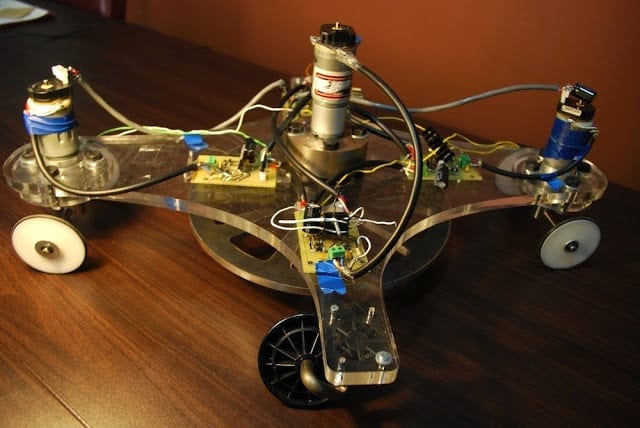 |
The ShakerBOT – Snakeboard inspired robot This is a insanely hypnotizing wheeled robot, that travels big zig-zagging around. Apparently it was inspired by something call “Snakeboards“, which I’ve never heard of. We have a similar wiggle cart for kids in the office, that we often like to hop on and drive between the aisles of inventory. It does not always go very well. Make sure you click through and check out the video! |
 |
1000 Fireflies – Electronics for 1000 Bicyclists Says the website, these are “interactive blinking LED devices outfitted with microcontrollers and radio units that allow them to mutually and observably synchronize with others, as do certain species of firefly.” It’s an ambitious undertaking, and the results look gorgeous. It’s not too far off our own version Firefly (well, not really, but kinda). |
|
Creating Illuminated 3D Objects with a Laser Cutter – Instructables Tutorial We like lasers, acrylic, 3D objects, AND lights. So needless to say, this is right up our alley. Instructables author theseeker did a great job using two-dimensional objects to create something three-dimensional. As a bonus, it even looks somewhat pixelated. The tutorial is pretty comprehensive, going all the way through the design, production, and final assembly. |
|
Iscar Chip Formation – Slow Motion During Steel Cutting Solarbotics has some Sherline equipment we use for machining fixtures and the like (yeah, machine tools are cool…). We tripped over this link that shows magnified and slowed video of what it looks like when a machine tool cuts steel. Looks like putty. Hypnotic! |
|
Mobile Lorm Glove – Communication Glove for Deaf-Blind Persons Some German developers have come up with a really great solution to help those that are deaf and blind to communicate via Lorm, a tactile sign language, through a glove with vibrating motors and a Bluetooth connection. It’s a really ingenious use of technology to make communication more accessible for those that have multiple impaired senses. |
Hopefully there was enough neat stuff in there to keep you distracted for a little while on our way to the final stretch before the weekend.
Friday! New stuff! Go!
|
Solarbotics Raspberry SAFE $8.95 Now that you’ve waited a long, long while for your Raspberry Pi® board to arrive you’ll want to protect your precious! Use the Raspberry SAFE to protect it from the harmful environment that is your desk. |
|
I2C-It Sharp IR Distance Sensor (10 to 80cm range) $16.45 We’ve turned this excellent standard-range Sharp IR sensor into something faster, and I2C compatible. |
|
I2C-It Sharp IR Long-range Distance Sensor (20 to 150cm range) $19.45 We’ve turned this excellent long-range Sharp IR sensor into something faster, and I2C compatible. |
|
RFID Reader ID-12 (125 kHz) $29.95 This is a very simple to use RFID reader module with a built-in antenna. Power the module, hold up a card, and get a Serial string output containing the unique ID of the card. |
|
RFID Reader Breakout Board $0.95 This is a simple breakout board breaks out the 2mm spaced pins from the ID-12 RFID reader out to two common 0.1″ spaced headers. |
|
5V 200mA Boost Converter $5.95 The NCP1402 is a 5V Step-up DC-DC converter. This breakout board will accept voltage inputs between 1 and 4 Volts and output a constant, low ripple 5V output capable of sourcing up to 200 mA. |
End of Friday! Weekend! Go!
The Ultimate Brutusbot Bundle is an Arduino-based platform that comes with everything (well, “batteries not included” still applies) you need to build your own functional Tank style Robot. This Do-it-Yourself Kit gives you the satisfaction of putting all the components of the robot together yourself, and each piece comes with its own detailed manual to walk you through each build. This kit comes with a Sharp Infrared Distance Sensor and Panning servo to immediately allow your robot to easily avoid obstacles within a full 180 degrees from the front of the Brutusbot. This sensor/servo combo makes it quite simple to get out corners and other sticky situations. The onboard LM1084 provides multiple servos with the voltage they need to operate (5V) and the ease of using any battery voltage between 6.5V – 16V. There are also multiple accessories available like the Armor Enhancement Kit, and the SAFE to keep your precious electronics out of harm’s way.
Features:
- Expandable! Has room for 8 servos and 6 analog sensors.
- Off-road abilities. We’ve tried dirt, rocks, and snow with smashing results!
- 5mm cut-outs on the front of chassis for LED head lights in low light applications.
- Arduino-programmable thru the Arduino IDE.
- 2A per channel L298 dual motor driver on board.
- All motor driver input pins are PWM ready for smooth speed ramping and slowing.
- On-board heavy duty 5V regulator that is capable of handling up to 5A!!!
- Sample code available under the Documentation tab.
- Theory of operation quickstart sheet available under the Documentation tab.
- Arduino shield compatible to give you more versatility via adding shields on top of the Freeduino.
- Blue anodized chassis with great custom art from Solarbotics’ talented graphic artists.
- 6xAA battery pack for a total of 7.2V for NiMH/NiCd Batteries or 9V for alkaline batteries.
Bundle Includes:
- BrutusBot Chassis Kit
- SB-Freeduino
- Solarbotics CMDR (Compact Motor Driver Robot) Shield
- HobbyKing 928BB Servo 2.0kg/ 9g/ 0.13sec
- Sharp GP2Y0A21 – Distance Measuring Sensor 10 to 80cm
- Sharp Sensor Cable, 20cm
- Ribbon cable (4 positions) (x8″)
- #2-56 x 5/8″ Phillips 18-8 S/S Pan Head Machine Screw (x2)
- Double-sided sticky tape
Please Note: For beginners, we recommend building the Tamiya twin motor gearbox in configuration ‘A’ as it’s the easier of the 2 configurations to put together. Be aware that the 16V maximum is a limitation of the 16V rated 220uF input capacitor on the Freeduino. Also, note that when placing the CMDR shield inside a SAFE you’ll have to bend the L298 back a little in order to place the lid on it.
Another Note: Keep in mind when interfacing the Freeduino & CMDR shield that we designed the CMDR shield to be R3 header compatible but unfortunately the Freeduino hasn’t caught up to this standard. For the time being, we are advising to either bend the pins outward on the side with the Freeduino caps that are in the way or snip them off if you don’t need them. One pin doesn’t make a connection it can be snipped without consequence, the other is an I/O reference (5V) pin that isn’t actually utilized at this time so it can be snipped too if you’d like. The SDA and SCL pins hanging off the other side can just be left as they don’t interfere with anything.
You save ~$10 (7.5%) over buying the parts individually.
Well, it’s been a riveting week. We did all sorts of exciting things, like definitely not riding a pallet jack down a flight of stairs and off a totally awesome jump. Nope, didn’t happen at all. And just like how our tech’s face didn’t connect with the ground after the jump he didn’t take, we thought it’d be a good idea to celebrate this not-event with some new connector-type-stuff. And a motor. Because everyone loves motors.
|
Mabuchi RF500TB Mabuchi Motor – $4.95 A very efficient, powerful, slow pancake motor. Mabuchi makes some of the best volume-manufactured motors in the world. They’re usually a premium over “clone” motors, but for good reason. |
|
2.1mm DC Power Plug Short – $1.75 This is a standard DC-style female plug, that comes as the connector itself plus a screw-on plastic casing. |
|
Telecom & Ethernet 4P-4C Clear Male Plug – $0.31 USD / $0.33 CAD This is the standard connection type that’s used for hooking up those wired telephone handsets that you barely see around any more. It has four pins, gold connections, and a clear housing. Exciting stuff. |
|
3-Pin Jumper Wire – F/F, 35cm – $1.95 USD / $2.05 CAD Each cable is 35cm (about 13.75″) long, and features a 3-pin JST Re connector at each end. They’re fairly standard units, often used on 0.1″ breakaway headers. |
|
1-Pin Jumper Wire – F/F, 16cm, Bundle of 10 – $3.95 USD / $4.15 CAD These jumpers come in packs of 10, and measure 155mm (6.1″) with a female connector at each end. They’re really helpful for jumping all kinds of things, such as going from board to board or whatever else you have in mind. |
|
Sharp Sensor Cable (20cm) – $1.95 USD / $2.05 CAD It can be a bit of a pain to get in there and solder up connections for a Sharp sensor, so we’ve brought in these 3-pin, 20cm (7.87″) cables to make life easier. This makes for a convenient connection to standard 0.1″ 3-pin headers, such as those used for servos. |
Look at all them connector things. The only challenge now is to find enough things for us to plug into other things. Just like how we definitely don’t need to plug in the watermelon launcher to remotely fire when someone hits the doorbell. Nope, that won’t freak out the delivery people at all…